Sunday, July 21, 2013

Beer Style Guide: American India Pale Ale (IPA)


The temperatures rise as we push nearer to August.  The rain storms of June have stopped, but the humidity has not.  Now is the season for lawn mower beers.  Today we will talk about what is arguably the most popular lawn mower beer in the craft beer industry:  The American India Pale Ale (IPA). 

As beers go this beer is relatively new on scene, but it parent beers the American Pale Ale, and the India Pale Ale have roots that date back hundreds of years.  The India Pale Ale dates back to the 18th century at the peak of British Colonization.  Pale ales were very popular at the time.  Now contrary to the name, the “Pale” in pale ales only means that is lighter than a porter (a heavy dark brown or red), and it covered a wide variety of beers we now call by different names.  As Britain colonized east including India there was a growing demand for British made beers, but there was a problem with the delivery service.  It took months for the wind powered ships of the days to make the voyage.  Now it is greatly disputed who was responsible for this, but someone figured out that if you put an abundance of hops in the beer that it would survive the voyage.  Thus IPAs were born. 

American Pale Ales was the beer that launched the craft brewery industry.  New Albion Brewery, started by Jack McAuliffe , was looking to brew something the big national brewers were not.  He started with heavily hopped (at least at the time, compared to today’s standards it’s pretty mild) pale ale.  While the brewery did not last for very long, it started the trend of craft brewing in the US, and it would have an early influence on Sierra Nevada Brewing, a brewery known for its hoppiness. 

The trend of hoppy beers became very popular in the craft brewing scene, creating a sub culture of beer drinkers called “hop heads”.  This lead to extreme breweries like Surly and Stone creating hoppier and hoppier beers.  Thus the American India Pale Ale was born. 

American IPAs generally start out with a caramelish or raisin like base malt.  They are then given a fruity or citrus like aroma hops, usually Cascade.  IPAs tend to be stronger and lighter in color then Pale Ales, but this is not always the case.  IPAs can range from straw gold, to a mid-range red.  Flavor wise, it is usually a characteristically citrus like hops, usually accompanied with a sweeter maltiness.  (Mosher, 2009)

HaymakerIPA
Just about every brewery these days makes some version of an IPA.  So finding a local version of an IPA should not be very difficult.

Minnesota:


Wisconsin:

Works Cited

Mosher, T. (2009). Tasting Beer: An Insider's Guide To The World's Greatest Drink. North Adams, MA: Storey Publishing.
Oliver, G. (2012). The Oxford Companion to Beer. New York: Oxford University Press.

Monday, July 8, 2013

Brews and Reviews: On the California Coast!

Just wrapping up a nice family vacation from the West Coast.  We spent a fair amount of days laying on the beach soaking up the sun (and I have the burns on my formerly pale Minnesota skin to prove it), and of course soaking up the local beer offerings.

So I will start with a local that is nationally known an can be found here. Now this is one of those beers I have had before, but this time I could say I was drinking it "local".  It's the legendary Anchor Steam.  Anchor Steam is still one of my favorite beers.  Smooth, noticable, but not overwhelming hops, and overall a well balanced beer.  I can't say for certain that it tasted "fresher" because I was closer to the source.  But it still hit the mark!  Rating 4 out of 3 Stars (Favorite)


Next our stop at BJ's Brewhouse.  For food I ordered their California Burger, and I had an Oasis Amber for a beer.  Now their beer was solid, refreshing, and tasted well.  But at the end of the day, it wasn't all that memorable.  Where I felt the shined was on the food.  Their fries were well cooked and seasoned, my medium rare burger was cooked to perfection, and the topping were fresh and added to the flavor of the burger.  It's really hard to judge a Brewpub on just one beer, but they definatly caught my interest and I look forward to going again.  Great food, and solid beers.


The first  new beer for our review is Bear Republic's Black Race IPA.  This inky black beer didn't let any light escape it.  It had a thick foamy dark head.  It head a thick warm mouth-feel.  There was a heavy cascade hops flavor and a fiery aftertaste (the abv is 8.1%).  There was a touch of smoke in the after taste.  A very different take on Black IPAs then what is available in Minnesota.  It was heavier, darker, and packed a punch.  Rating: 1 1/2 out of 3 stars (Good).


Ballast Point Amber Ale Calico:  This hazy dark red beer had a nice thick foamy head.  The aroma was a white grape followed by a citrusy aroma.  It hit you first with a shock of bitterness.  It was a muddled mixture of cascade hoppiness, but there were others hops noticeably at play in this beer.  It had an almost lavender flavor to it, especially in the after taste.  Nice and bold, a definite drink for the hoppy people in your life.  Rating 1 1/2 Stars out of 3 (Good).

Hanger 24 Amarillo Pale Ale:  This hazy orange beer with white foamy head gives off a faint citrus aroma.  It had ample, but soft, carbonation.  Mild bitterness, it had a nice lingering maltiness to it.  It was a good hearty beer perfect for summer time.  Rating 2 Stars out of 3 (Very Good).


Last and definitely not least is what I'm calling the star of our trip:  Fireman's Brew Blonde Pilsner.  This beer was light golden in color with a slight orange tint.  Head of fine bubbles, nice fresh saaz hops aroma.  The taste reminded me of one of my favorite German Pilsners, Hohenfelder.  Nice crisp bitterness, pleasant nutty maltiness.  It was smooth, crisp, and very good.  I found that you could drink this beer chilled, or just under room temperature and you still had a fine beer.   Overall this was my favorite beer of the trip.  Rating:  3 Stars out of 3 Stars (Excellent).


Overall I has very happy with my beer experience in California.  This state is known for having some of the best beers in this country, and I tend to agree.  Mixed with a fine food culture this is a definite trip to take when you are looking for a new Beer Adventure.

Until next time.  Keep those mugs full!


Friday, June 28, 2013

Adventures of a Beginning Homebrewer: Upgrade to Make Life and Brew Better!

Adventures of a Beginning Homebrewer


Upgrade to Make Life and Brew Better!


So you have made a few batches of beer now with your basic brewing kit, you got the hang of it and things are tasting good. Where do you go from here? One word… Upgrades!


There are so many upgrades you can add to your home brewery to make life easier and to make brewing quicker. The list is virtually endless. I am going to concentrate on a couple of relatively inexpensive upgrades that I have made that have helped my home brewery become more efficient. After all, brewing takes time, so efficiency opens up time to make even more beer!


The very first upgrade I made to my set up was a wort chiller. After you do your boil you want to be able to get your wort temperature down below 100 as soon as you can. The longer this process takes the more susceptible your wort is to infection by bacteria and such in the air.


When I first started brewing I had a HUGE bucket that I would fill halfway with ice, then set the covered brew kettle in the ice bucket, top with ice, and then wait…. and wait… and wait… and… you get the picture. Sometimes this could take up to an hour plus! What a waste of time, not to mention I wasted a lot of cash on 20 pound bags of ice.


So, I got myself a wort chiller. A wort chiller is a coil of copper or steel tubing you set in your wort that hooks up to your faucet. Crank on the cold water and it forces the cold water through the tubes, thus chilling your wort quickly. And I mean QUICKLY! It now takes me less than 20 minutes to have my wort to a suitable temperature. My wort is in the elements for a much shorter amount of time and I can go about my day sooner… or start the next batch sooner!


There are several different types and sizes of wort chillers. You can pay anywhere from 70 to 200 bucks for one. I purchased the cheapest one I could find and it works great and has been used on countless batches of beer. If you are rich, you can get yourself the $200 model, but if you are reasonable, just get the basic one and save your cash for other upgrades.


The other upgrade I swear by is a larger siphon and hose. Most brewing kits come with a 5/16” auto siphon. But, for a mere 14 bucks and a few bucks for new hose you can get a 1/2” auto siphon. Maybe it doesn’t sound like much of a difference, but trust me when I tell you; this thing makes racking beer a breeze! It cuts the time it takes to rack beer in half. It is worth every penny, especially for a guy like me who usually has more than one batch to rack at a time.


These two upgrades probably save me about an hour per batch and they didn’t break the bank. Anybody else out there have an upgrade you have made to your brewery you can’t live without?


Cheap wort chillers: 


Larger auto siphons:


Monday, June 17, 2013

Rise of the Beer Baron Pt 3.: Return of Craft Beer!

So when I last left off my friend Collin was turning 22 and my crew of friends were just starting to dip our toes into the alcohol scene.  Collin had a brother who lived out in California (one of the great starting points of the craft beer movement) and for his birthday signed him up for a beer-of-the-month club, and this was my first introduction to what would later become my obsession with craft beer.  I don't exactly remember every beer that was in there but I remember there being some Dog Fish Head and a beer called "Hempen' Ale" made out of hemp seeds.  For us the latter was more about the novelty of drinking weed:
 

I know that I didn't like most of the beers I drank, and when I think back on it it was probably because they challenged my perception of what beer was, namely it wasn't the beer my Grandpa drank.  To this day I regret not being more into beer, and not seeing past light American Lagers.  I held in my hand what was arguably one of the most prolific beers in Craft Beer History (referring to Dog Fish Head), and I didn't quite appreciate it as much as I would have today.  But life must go on, and so it did and I continued in my near ignorance of beer and started dabbling in 7 and 7 and other fruit based shots.

And that was how life was for my early to mid 20s. Now during my high school days I was your classic D&D/Boy Scout/Star Trek nerd.  Too this day a lot of those tendencies have not left my spectrum of interests. The only problem was in my workplace, a small ma&pa grocery store called D&K Foods, there were no other nerds to geek out with.  So I started taking in interest in their passions.  One meat cutter, named Paul, introduced me to professional football, and in specific his team:  The Green Bay Packers. 

Now I don't want to start a border war here, because this is about great local craft beer no matter where you are from.  I don't have any issues with the Vikings, they just aren't my team.  I love a good rivalry, but I think fans on both sides of the fence take it WAY too far.  So let me enjoy my team.

I started hanging out with a group of Packer fans, and we regularly went out to watch games on Sunday.  Now as a Packer fan, I couldn't just sit their and drink "fruity drinks" without being poked fun at by my fellow Cheeseheads.  So I started drinking Leinenkugels's Honey Weiss, and yes I took it with a wedge of lemon when offered.  Now I was officially a beer drinker!  So how did I become a "craft beer" drinker.  Well that took some cheese, and a doctor....

To Be Continued...


Tuesday, June 11, 2013

Adventures of a Beginning Home Brewer - Time for Something Completely Different


It seems a bit early, but the other day a good friend of mine and I were talking about Thanksgiving. It’s got to be the best holiday. Great food, great drinks, football, no holiday shopping; you just can’t beat it.
 
I think we all know the basics of what food will be served, but what about the beer? Many first thoughts are pumpkin beers, but truth be told I can’t stand them. Never found one I liked. Stouts and porters might be a bit heavy for the type of eating that is going to go down. How about a hard cider? Fall flavors are what Thanksgiving is all about, and what is more fall than apples?

I know, I know. Hard cider isn’t a beer. But this is Adventures of a Beginning Home Brewer. Beer isn’t even in the title… ok, so maybe it is implied since this blog is part of Beerploma, but bear with me just for one post.
 
It became apparent that it's time to make a tasty hard cider. But of course, I am a beginner and have no clue how to make a hard cider. Ahhhh… Isn’t the internet great? I did some research and found out some basics.
 
The first tip I found is that there is no boil for hard cider as there is in beer. If you boil apple juice it can take on a bit of an astringent flavor. But no boil = potential contamination of the cider. I found two ways to combat this.
 
The first way is to purchase unpasteurized juice (or buy apples and juice them) and heat the juice, but not boil it. This can make things sterile, but you must be careful. Over do it and you have an off taste in your cider. Under do it and you may get some contaminated cider. Nether sound good to me!
 
The second way is the way chosen for this experiment. Purchase pasteurized apple juice. This makes it free from contaminants while keeping the juice in its same tasty condition. Be sure to purchase a good pasteurized cider that contains no chemical preservatives like potassium sulfate or sodium benzoate. These things prevent bacteria and mold growth, but also prevent yeast growth. In other words, your yeast won’t work with juice containing chemical preservatives. And if the yeast doesn’t work, you don’t have hard cider.
 
For the yeast, most will work. The guy at Northern Brewer suggested champagne yeast. It will eat a ton of sugar and carbonates well in the end. And it won’t deliver an overly yeasty flavor that may be tasty in some beers, but probably wouldn’t be too great in a hard cider.
 
After figuring that stuff out making hard cider, at least to the primary stage, is a piece of cake! Pour pasteurized apple juice into a fermenter, add yeast, and seal! The part that took the longest was sanitizing. But since I was also firing up a raspberry rhubarb wheat and bottling an EPA, it really took no extra time to sanitize a bucket, top, and airlock.

As of this morning it was bubbling away in the primary, so that’s a good sign things are headed in the right direction. I will follow up on this cider later down the road as developments come about. Have you brewed a hard cider, and if so how did it go? Any advice would be greatly appreciated.

Monday, June 3, 2013

Cream Ales, The Other Summer Beer!


I’m gonna start this post off with a little secret for all of our regular readers.  Some BIG changes are coming to Beerploma.com.  I’m not talking about a logo face lift, although that is part of it.  I’m talking about something BIG!!!

With that said I feel that our recent articles have gotten away from our primary mission:  Educating Craft Beer Drinkers about GREAT local beers.  So as such I would like to start steering the ship back onto the correct course.  So class is in session, and speaking of sessions it’s time to talk about one of my favorite session styles.  Just in time for spring, let’s talk about Cream Ales!

First let’s talk about the history of cream ale.  They first came into popularity before Prohibition in the Northeast/Mid-Atlantic in order to compete with mass produced American Lager (Oliver, 2012).  Taste wise Cream Ales should be light, hoppier then American Lagers, and often have a light fruity taste.  The color should be a pale straw to pale cold and the APV should be between 4.2% and 5.6% (Mosher, 2009).  Cream Ales being a lighter fare should be paired with salty snacks; basically treat them like you would an American Lager.  

Minnesota and Wisconsin are both home to two of the finest Cream Ales in this country.  I’m of course talking about Rise To the Top,by Third Street Brewhouse and Spotted Cow, by New Glarus.  Both are great examples of this great session beer and both are great at showcasing better different aspects of Cream Ales.  Spotted Cow shows off the fruity-ness of the style while Rise to the Top shows off the hop potential.  Both are excellent beers, and I highly recommend sampling the two side by side if you ever get the chance. 

Minnesota Cream Ales:


Other Cream Ales:


So now that the snow has finally melted, and we trade in snow-blowers for lawnmowers its time to trade in the porters for cream ales!  Until next time, keep those glasses full!

QUESTION OF THE WEEK:  Which of these beers would win in a Border Battle Royal?  Rise to the Top or Spotted Cow!

Leave your answers in the comments section or on Twitter @beerplomadotcom or on our Facebook Page! 


Works Cited

Mosher, T. (2009). Tasting Beer: An Insider's Guide To The World's Greatest Drink. North Adams, MA: Storey Publishing.
Oliver, G. (2012). The Oxford Companion to Beer. New York: Oxford University Press.

Monday, May 27, 2013

An Adventure to Castle Danger!!!!

Before I get to the cheesy title I would like to talk about the other dragon I have slain this week.  My Father-in-law, Hubert, is visiting from Germany this week.  He normally has a good taste for GREAT pilsners on his home turf but someone got him in a bad habit of drinking Budweiser.  Well this week I convinced him to try Grain Belt Premium.  And while this might not be the shining example to some craft beer drinkers (I personally like it), at least I am keeping it local.  That and he has been doing some major damage to my stash of August Schell's Zommerfest.


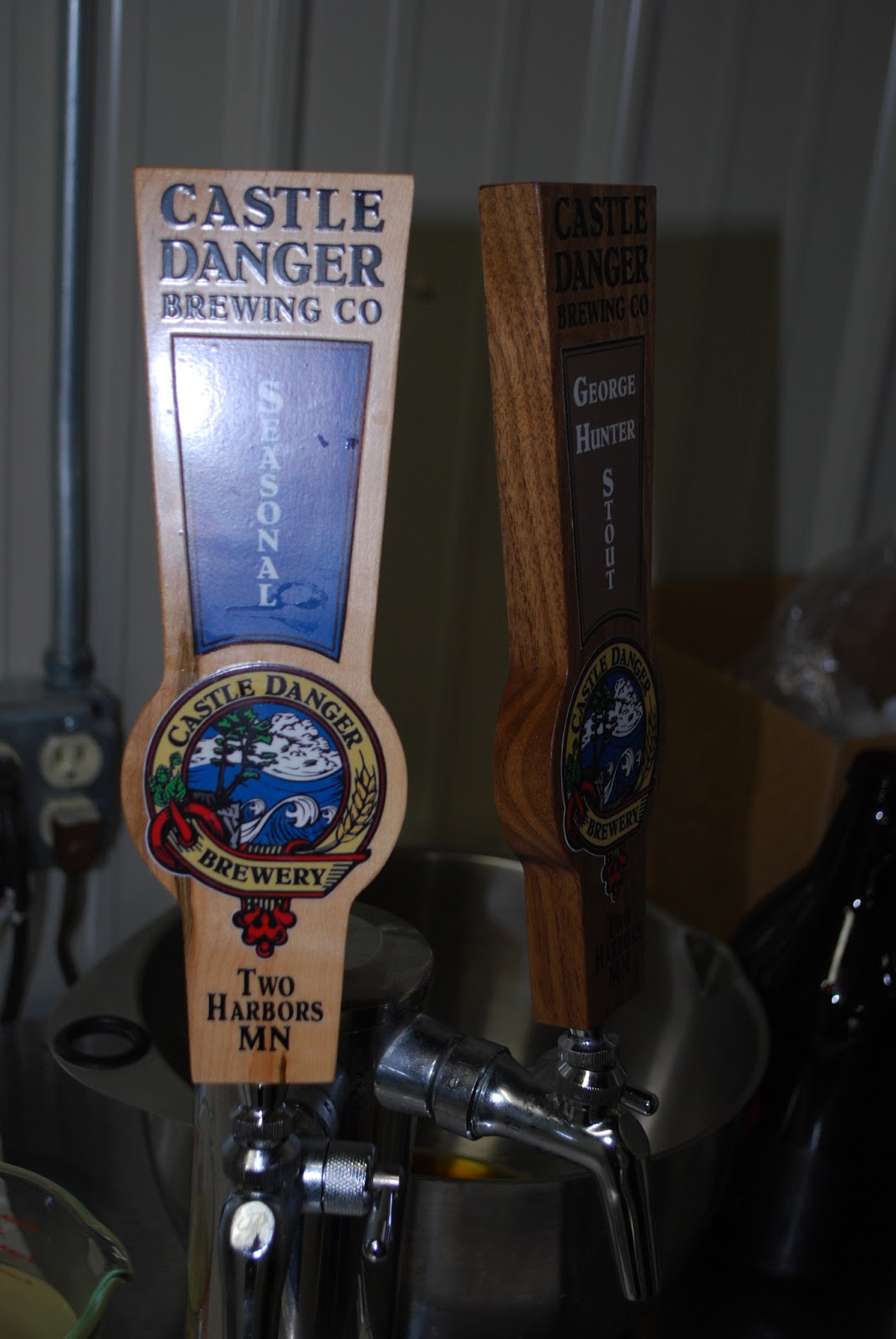
For those of you traveling the North Shore this summer you are in for a treat.  The Duluth Area has new breweries opening left and right.  But don't forget the breweries in other parts of this great scenic drive.  While on a little family get-a-way I had pleasure of visiting Castle Danger Brewing, in Castle Danger, MN just a little over 10 miles north of Two Harbors (just a hint, bring driving directions if you decide to go, my two GPS units in the car failed to find the place).


Now for those of you used to going into breweries in the city might be in for a little shock, because this brewery is set up in the space that is about the size of your average garage.  But don't let its small size fool you, this brewery packs some flavor!  You are instantly greeted by friendly faces offering you a taste of their wares from the makeshift tap room.  I got the chance to taste 5 of their beers:  Danger Ale, Nordic, Gale Force Wheat, Double Crossing IPA, and George Hunter Stout.


All five beers were solid, and definitely all worth the trip if you are in the area.  For me three of them stand out as noteworthy:

1.  Nordic:  This is Castle Danger's take on a Finish Sahti style of beer.  Made with Juniper Berries for a bittering agent (usually in place of the hops).  This beer had a thick golden color, and a hearty and sharp aroma which translated easily into the taste.  It was, in my opinion, even a more robust beer then their stout.  The rye in the beer gave it a thick mouth feel, and it finished clean.  For those looking for something different from the craft beer industry needs to look no further then Castle Danger's Nordic!

2.  Double Crossing IPA:  Seeing brewers buck the trend of over-hopped (or as I like to say over-hyped) IPAs makes me smile.  Double Crossing IPA is a great IPA because it actually tastes like something other then grapefruit.  It has a very fruity taste, and is thick.  It was tasty and is a great IPA that can be enjoyed all year round!

3.  Gale Force Wheat:  When picking my growler this is what I decided to take home.  This was a softer more gentler take on a wheat beer and was perfect for spring time at the cabin.  This beer is a little hard to describe, as it is not your typical wheat, but don't let that statement make you think any less of it.  It had a noticeable clove/banana flavor that accompanies a true German wheat style, but the hops felt a little more prevalent in this beer.  For me this was the perfect spring time beer.  When I crack open the growler I will write a little more in-depth review of it.

So with another brewery under my belt I was happy, and my adventure had come to an end.  It was time to return to our rented Cabin and enjoy some family time.  But the next day held a little surprise when we stopped for lunch at the Rustic Inn Cafe & Gifts, also located in Castle Danger, MN.  Their feature beer is...you guessed it, Castle Danger.  They also included Castle Danger beer in some of their recipes including the beer batter used to make the Onion Rings (pictured below is Beth Sullivan, one of the co-owners making the beer batter).  The food is some of the best I have had along the North Shore, and their pies are top notch to boot!

Over all it was quite the Beer Adventure for that little family getaway.  So if you find yourself in the area this summer stop in at Castle Danger and have your own adventure!